
Raydium LaunchLab review
Raydium's bonding-curve program on Solana and the engine behind LetsBONK, StonkFun and other branded launchpads. We checked its fees, audits and incident record against Raydium's docs, its public LaunchLab API and its GitHub audit folder on 17 October 2026.
Facts checked . How we checked
Our verdict
Raydium LaunchLab is the bonding-curve program of Raydium, a Solana DEX. A curve trade on raydium.io costs 1.05%: Raydium's 0.25% protocol fee, a 0.75% platform fee and a 0.05% creator fee. The fee is $1.05 on a $100 trade and $10.50 on a $1,000 trade. Other launchpads, such as LetsBONK, run their own front ends on the same program and set their own platform fee.
LaunchLab has a published audit: Halborn audited the launch program in 2025, and Raydium runs a bug bounty on Immunefi. Raydium itself has had two exploits, in December 2022 and June 2026, and neither touched LaunchLab. The fee you pay depends on the front end, so read the full quote before you trade.
Fees: Curve swaps can include separate protocol, platform and creator fee components. The total depends on the launch configuration; post-graduation CPMM fees follow the selected pool configuration.
Best for
- Creators who want a Solana curve launch with a published audit and a Raydium CPMM pool after graduation
- Traders who want a lower curve fee than the pump.fun app or LetsBONK, by trading on raydium.io directly
- Launchpad builders who want to run a branded front end with their own fee settings, without their own on-chain program
Skip it if
- You want one fixed fee for every LaunchLab token. Each front end sets its own platform fee, up to 5%
- You want to keep the locked-LP Fee Key as a creator. Since 17 August 2026 that key goes to the platform
- You trade on BNB Chain, Base or Robinhood Chain. LaunchLab runs only on Solana
Strengths
- Halborn audited the LaunchLab program in Q2 2025, and Raydium's GitHub publishes the report
- All fee rates are public in Raydium's LaunchLab API, so you can check each front end yourself
- A curve trade on raydium.io costs 1.05%, less than the 1.5% on LetsBONK and the 1.70% in the pump.fun app
- Graduation moves the token into a Raydium CPMM pool, and most of the new LP is burned
- Raydium runs a bug bounty on Immunefi for its programs
Limitations
- Front ends set their own platform fee, up to 5%, so one percentage does not describe every LaunchLab token
- Raydium's other programs had exploits in December 2022 and June 2026
- The program changed often in August and September 2026, and we found no newer LaunchLab audit than the Q2 2025 report
- Since 17 August 2026 the locked-LP Fee Key of new migrations goes to the platform, not to the creator
- Raydium does not intervene in launches that fail to graduate
fees · 24h
$36.5K
fees · 30d
$3.53M
fees · all-time
$108.90M
Source: DefiLlama · Fee data fetched · Raydium LaunchLab statistics →
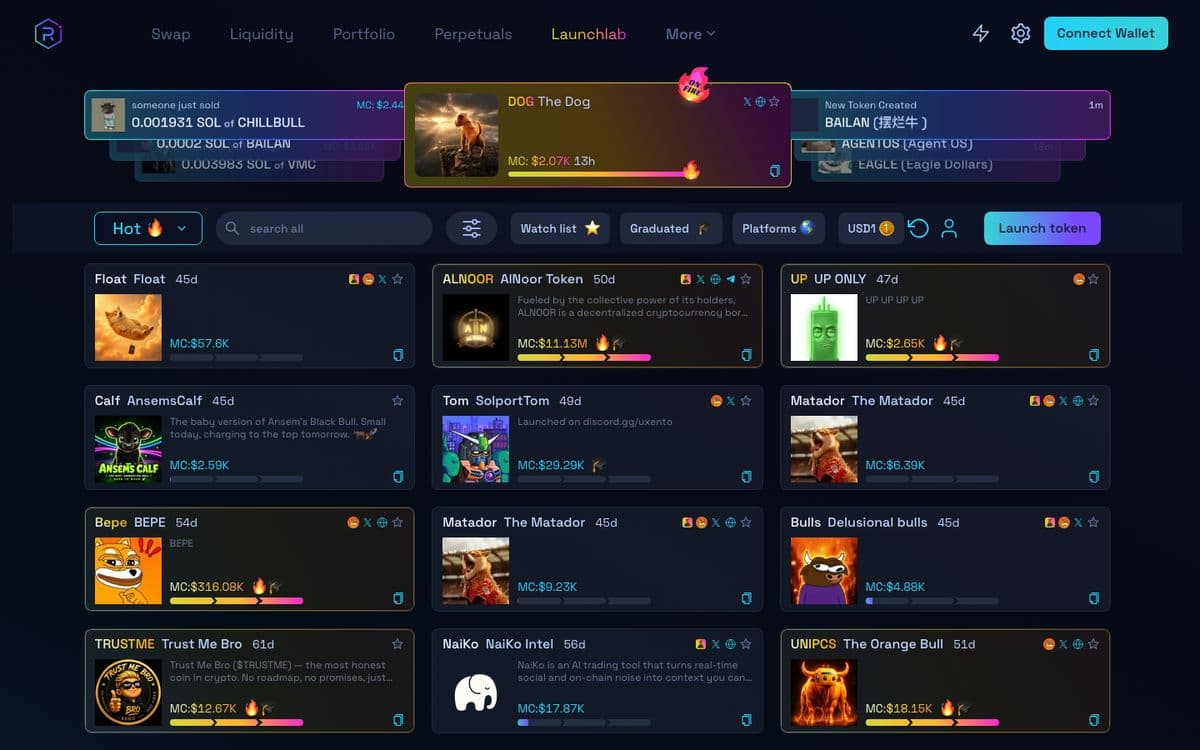
What is Raydium LaunchLab?
Raydium LaunchLab is the bonding-curve launchpad built by Raydium, a decentralized exchange on Solana. A token launched on LaunchLab trades on a curve first. When the curve reaches its target, the liquidity moves into a Raydium CPMM pool. Read how a bonding curve works for the mechanics.
LaunchLab has a second role: other launchpads build on it. Raydium's LaunchLab API listed 21 platform configs on 17 October 2026, including LetsBONK, StonkFun, Bankr and SURGE. Each front end has its own platform config, which sets its platform fee, its creator fee and which curve shapes creators may use. Raydium's own front end at raydium.io/launchpad is one of these platforms.
Creators can launch in two modes. JustSendit uses fixed settings and graduates at 85 SOL. LaunchLab mode lets the creator set the target, from 24 SOL up, and choose to sell 51% to 80% of supply on the curve. The rest of the supply seeds the pool after graduation. LaunchLab mode also allows optional vesting for team wallets.
Is Raydium LaunchLab safe?
LaunchLab has a published audit and a known operator, but the tokens on it carry the usual memecoin risk. Raydium's GitHub audit folder holds a Halborn report on the Raydium launch program from Q2 2025. The same folder holds audits of the CPMM program by MadShield in Q1 2024 and Sec3 in Q3 2025, and a Halborn audit of liquidity locking from Q4 2024. Raydium's docs send security reports to its bug bounty on Immunefi. DefiLlama's LaunchLab listing shows 0 audits and links none of these reports.
LaunchLab changed often after that audit. Raydium's changelog lists new rules on 17 August, 26 August, 31 August, 9 September and 19 September 2026, from CPMM-only migration to a new protocol share of creator fees. We found no LaunchLab audit in the folder dated after Q2 2025.
You trade from your own wallet, and Raydium does not hold your funds. The risk sits in the programs, in the front end that you use and in the token. Raydium's guide says that LaunchLab does not intervene in launches that fail to reach graduation. It also warns that a creator who skips the first buy can lose early tokens to sniping bots.
Front ends add their own risk. In March 2026 attackers took over the domain of BONKfun, a LaunchLab front end, and drained some wallets, as our LetsBONK review explains. Check the address before you connect a wallet. Read our memecoin survival study before you buy a new token.
Raydium's incident record
Raydium has had two exploits, and neither involved LaunchLab. DefiLlama's hack list records a malware attack on Raydium AMM on 16 December 2022, with about $4.4 million lost.
On 10 June 2026, Raydium's infrastructure contributor @0xINFRA said on X that an attacker had removed liquidity from the legacy AMM V3 program, which Raydium phased out in 2021. Five old pools lost assets worth about $1.34m. The post said that the flaw was a missing check of the LP mint, not a key compromise, and that current Raydium programs and users were unaffected. It said that Raydium's treasury would pay full compensation and that core contributors were reviewing all mainnet programs.
Raydium LaunchLab fees
Every curve trade can carry four fees that add together. Raydium's global config sets a 0.25% protocol fee. The platform config of the front end adds a platform fee and a creator fee. An app that routes the trade can add a referral fee, which Raydium caps at 1%. Raydium's docs list all four as additive.
On raydium.io, Raydium's own platform config sets a 0.75% platform fee and a 0.05% creator fee, per the LaunchLab API on 17 October 2026. A curve trade there therefore costs 1.05% in total, plus any referral fee. On LetsBONK, the two configs that new launches use set a 1.25% platform fee and no creator fee, so a curve trade costs 1.5%. Since 26 August 2026 a front end can set a platform fee of up to 5%. Platform and creator curve fees collect in vaults and must be claimed.
After graduation, the CPMM pool config sets the fee. The config that raydium.io launches use charges a 0.25% trade fee and has a 0.05% creator fee rate. Raydium's CPMM docs say that the creator fee is charged on top of the trade fee, and only on pools created with the creator fee turned on. Of the 0.25% trade fee, LPs keep most, and the protocol and Raydium's fund take 12% and 4%. Solana network fees are extra.
Worked example: a $100 and a $1,000 trade
A $100 curve buy on raydium.io pays $1.05: $0.25 to Raydium as the protocol fee, $0.75 to the Raydium platform and $0.05 to the creator. A $1,000 buy pays $10.50: $2.50, $7.50 and $0.50. A sell of the same size pays the same fees. A $100 round trip on the curve therefore costs about $2.10 before network fees and price impact.
The same $1,000 curve buy through LetsBONK pays $15.00: $12.50 to LetsBONK and $2.50 to Raydium. A front end with a 5% platform fee would charge $52.50 on the same trade. Always read the total in the trade quote.
After graduation, a $1,000 trade in a raydium.io CPMM pool pays $2.50 in trade fees, plus $0.50 if the pool has the creator fee turned on. Most tokens never reach that stage. Our guide to memecoin graduation explains what changes for traders after the move.
Graduation, LP burn and creator rewards
When the curve's SOL vault reaches the target, Raydium moves the liquidity into a CPMM pool. The move is one way: the token does not go back to the curve if the price falls. Since 17 August 2026, new launches must migrate to CPMM.
The platform config decides what happens to the new LP tokens. Raydium's own config burns 90% of them and locks 10% with a Fee Key NFT, which carries the right to that share of the pool fees. For migrations after the 17 August 2026 upgrade, that Fee Key goes to the platform. Creators who migrated before the upgrade keep their Fee Keys.
Creators can still earn in two ways. The curve creator fee accrues when the platform enables it, and on raydium.io it is 0.05% of each curve trade. After graduation, the CPMM creator fee pays the recorded pool creator. Since 17 August 2026 anyone can trigger the collection of that fee, and the funds still go only to the creator. Since 19 September 2026 the protocol can keep a set share of the creator fee at collection, and the default share is 0. Read how creator fees work to compare launchpads.
Who should use Raydium LaunchLab?
Traders who want the lower curve fee should trade LaunchLab tokens on raydium.io, where a trade costs 1.05% before any referral fee. Creators who want a launch with a published audit and a move into a Raydium pool can launch directly on raydium.io. Creators who want to set their own target, sell a custom share of supply or vest team tokens should use LaunchLab mode.
Creators who want a community or a brand should look at a branded front end such as LetsBONK, and accept its higher fee. Builders who want their own launchpad on Solana can register a platform config and set their own fees. LaunchLab is a poor fit if you want the locked-LP Fee Key for yourself, or if you trade outside Solana.
Raydium LaunchLab vs pump.fun
pump.fun is the closest alternative, because it is the largest Solana curve launchpad. A bonding-curve trade in the pump.fun web app or mobile app costs 1.70%, or $17.00 on $1,000, because of a Platform Fee added on 17 October 2026. Through pump.fun Terminal or another app, the pump.fun fee is 1.25%, or $12.50, plus the fee that the app charges. A LaunchLab curve trade on raydium.io costs 1.05%, or $10.50 on $1,000.
pump.fun graduates its tokens into its own PumpSwap pools, and LaunchLab graduates into Raydium CPMM pools. pump.fun pays creators a share of its curve fee, and LaunchLab pays the creator whatever the front end sets: 0.05% on raydium.io and 0 on LetsBONK. See pump.fun vs Raydium LaunchLab for the live numbers side by side.
LetsBONK is the best-known LaunchLab front end. Its curve costs 1.5%, which is more than pump.fun's 1.25% curve fee and less than a curve trade in the pump.fun app. Jupiter Studio and Meteora DBC are other Solana options. See Jupiter Studio vs Raydium LaunchLab and Raydium LaunchLab vs Meteora DBC to compare them.
Raydium LaunchLab referral code
We found no referral program for traders on LaunchLab, and MemeFees holds no LaunchLab code. The program does let an app take a referral fee of up to 1% on each curve trade, which raises the cost for the trader. Check the quote for a referral fee before you trade through a third-party app.
Raydium LaunchLab fee table (raydium.io)
| Cost | Amount | Note |
|---|---|---|
| Token launch | No published Raydium fee | Hold about 0.1 to 0.5 SOL for creation and vault rent in LaunchLab mode. |
| Raydium protocol fee | 0.25% of each curve trade | Set in the LaunchLab global config. Applies on every front end. |
| Platform fee | 0.75% on raydium.io | Each front end sets its own, up to 5%. LetsBONK sets 1.25%. |
| Curve creator fee | 0.05% on raydium.io | Set by the platform config. LetsBONK sets 0. |
| Referral fee | Up to 1% | Added only when an app that routes the trade sets one. |
| Graduation | 85 SOL (JustSendit) or a target of 24 SOL or more | Liquidity moves into a Raydium CPMM pool. Raydium's config burns 90% of the LP. |
| CPMM pool after graduation | 0.25% trade fee + 0.05% creator fee | The creator fee applies only on pools created with it turned on. |
| Example curve trades | $1.05 on $100, $10.50 on $1,000 | raydium.io, before any referral fee, network fees and price impact. |
Sources: Raydium LaunchLab API (launch-mint-v1.raydium.io/main/platforms and /main/configs), Raydium CPMM config API (api-v3.raydium.io/main/cpmm-config), Raydium docs (LaunchLab and CPMM fee reference, CPMM fees, creating a LaunchLab token, changelog), the raydium-io/raydium-docs audit folder and raydium-cp-swap README on GitHub, the @0xINFRA post on X of 10 June 2026 and DefiLlama's protocol and hack data. All checked on 17 October 2026.
Raydium LaunchLab fees compared
| Launchpad | Platform fee terms | Launch cost | Chains | Fees, last 30 days |
|---|---|---|---|---|
| Raydium LaunchLab | Curve swaps can include separate protocol, platform and creator fee components. The total depends on the launch configuration; post-graduation CPMM fees follow the selected pool configuration. | Network fees and account/vault rent; review the launch quote | Solana | $3.53M |
| pump.fun | 1.25% bonding-curve trading fee before any app fee, including a 0.30% creator fee. From 17 October 2026, trades in the pump.fun web and mobile app add a 0.45% app fee (0.40% with a referral code); pump.fun Terminal and other apps do not charge it, but they charge their own trading fee. PumpSwap canonical-pool fees vary with market cap and quote asset; network fees are separate. | No platform launch fee; network fees apply | Solana | $44.04M |
| LetsBONK.fun | A curve trade pays 1.5%: a 1.25% LetsBONK fee plus Raydium's 0.25% protocol fee. The revenue dashboard allocates 51% of platform revenue to BONK purchases for the BNKK treasury, not to burning those tokens. | Network and account costs apply; review the launch quote | Solana | $2.95M |
| Jupiter Studio | The documented base fee is 1% on buys and sells before and after graduation, split equally between the creator and Jupiter. An additional anti-sniper fee can apply to early buys. | Not published by the platform | Solana | $8.4K |
| Meteora DBC | Integrator-configurable trading fees. Meteora's protocol share is 20% of the total trading fee. Migration adds a 0.2% protocol liquidity fee. | Varies by integrating frontend | Solana | $1.14M |
Fee terms: each platform's own docs, as listed in the MemeFees launchpad registry. Fees, last 30 days: DefiLlama, the fees each platform collected, not a rate per trade. “Not tracked” means DefiLlama reports no figure for that platform. Fetched .
Frequently asked questions
Is Raydium LaunchLab safe?
Halborn audited the LaunchLab program in Q2 2025, and Raydium runs a bug bounty on Immunefi. Raydium's older programs had exploits in December 2022 and June 2026, and neither touched LaunchLab. The tokens on LaunchLab can lose all their value, and front ends can be attacked.
Is Raydium LaunchLab legit?
Yes. LaunchLab is the launch program of Raydium, a Solana DEX that DefiLlama tracks. Its fee settings are public in Raydium's LaunchLab API, and its audit reports are on Raydium's GitHub.
What are the Raydium LaunchLab fees?
On raydium.io a curve trade costs 1.05%: a 0.25% Raydium protocol fee, a 0.75% platform fee and a 0.05% creator fee. The fee on a $1,000 trade is $10.50. Other front ends set their own platform fee, up to 5%. After graduation, the raydium.io CPMM pool charges 0.25%.
Is Raydium LaunchLab free to use?
Raydium publishes no separate creation fee, but its guide says to hold about 0.1 to 0.5 SOL for creation and vault rent in LaunchLab mode. Every curve trade pays the protocol, platform and creator fees.
How much SOL does a LaunchLab token need to graduate?
A JustSendit launch graduates at 85 SOL. In LaunchLab mode the creator sets the target, and it must be at least 24 SOL. The liquidity then moves into a Raydium CPMM pool.
Is LetsBONK the same as Raydium LaunchLab?
No. LetsBONK is a branded front end that runs on LaunchLab. It sets a 1.25% platform fee and no creator fee, so its curve costs 1.5%, while a curve trade on raydium.io costs 1.05%.
Is Raydium LaunchLab cheaper than pump.fun?
On raydium.io, yes. A LaunchLab curve trade there costs 1.05%, and a curve trade in the pump.fun app costs 1.70%. Through pump.fun Terminal or another app, the pump.fun fee is 1.25%, plus the fee that the app charges. On another LaunchLab front end, the cost depends on its platform fee.
Do creators earn rewards on Raydium LaunchLab?
Creators earn the curve creator fee that the front end sets, 0.05% on raydium.io, and a CPMM creator fee after graduation if the pool enables it. Since 17 August 2026 the locked-LP Fee Key of new migrations goes to the platform.
Related
How we checked
- Facts checked
- . On that date we compared the facts on this page with the sources below.
- Data refreshed
- . The fee figures come from DefiLlama and update without a new review. Raydium LaunchLab live statistics.
- Primary sources
- Not tested
- We did not launch a token or place trades on Raydium LaunchLab for this review.
We are independent and not affiliated with Raydium LaunchLab. The activity figures give context. They do not measure execution quality or safety. Read our methodology.
Memecoins can lose their entire value. This page gives general information. It is not financial advice.