
Bags review
The Solana and Robinhood Chain launchpad that pays a share of every trade to the social accounts named at launch. We checked its seven fee modes, its contracts and its invite link against the Bags docs on 17 October 2026.
Facts checked . How we checked
Our verdict
Bags is a working launchpad on Solana and Robinhood Chain. Its main feature is the fee split: every launch must name the people who earn from trading, and the claimers pool gets half of each non-compounded fee. In the default mode a trade costs 2%, and half of that fee goes to the people named at launch.
Use Bags if you launch a token with a partner, a community or the person behind the meme, and you want each of them paid on chain from the first trade. As a trader, check the fee mode of each token before you buy, because one Bags token can charge 0.25% per trade and another 10%. In the default mode, a curve trade on Bags costs more than a curve trade in the pump.fun app.
Fees: Solana default mode: 2% per trade, half to the platform and half to fee claimers; six other modes set other rates. Robinhood Chain: a flat 2% on the ETH leg.
Referral link. We may earn a commission when you sign up through it. Bags referral terms.
Best for
- Creators who want to share trading fees with up to 100 X, Kick or GitHub accounts, set at launch
- Tribute launches, where the person who inspired the meme gets a share of every trade
- Developers who want to launch tokens through a documented API or command-line tool
- Creators who want a Robinhood Chain launch with a Uniswap v4 pool and locked liquidity after graduation
Skip it if
- You trade often and want the lowest fee. The default Bags mode charges 2% on every buy and sell, before and after graduation
- You expect a reward for using the Bags invite link. Bags has published no benefit for the person who joins through it
- You want every contract to have a public audit. We found no audit report in the Bags docs for its own fee-share program or its Robinhood Chain contracts
Strengths
- No Bags fee to create a token through the API on Solana, only transaction costs. Robinhood Chain charges 0.02 ETH by default
- Fee sharing is part of every launch, with up to 100 fee earners per token
- Seven fee modes on Solana, from 0.25% to 10% on the curve, so the creator sets the cost of trading
- Solana launches run on Meteora's bonding curve and pool programs, which list audits by Offside Labs, OtterSec and Zenith
- Fee rates, program IDs and contract addresses are public in the Bags docs, so you can check them yourself
Limitations
- The default mode charges 2% per trade, which is more than the 1.70% that a curve trade costs in the pump.fun app
- The fee mode is fixed at launch, so the creator cannot lower the trading fee later
- The fee-share admin of a token can change the claimers and their shares after launch
- On Robinhood Chain, the factory and vault contracts are upgradeable, and the docs do not name the owner address
- Fee claimers named by social account are paid to a Bags embedded wallet linked to that account
fees · 24h
$6.2K
fees · 30d
$385.6K
fees · all-time
$64.87M
Source: DefiLlama · Fee data fetched · Bags statistics →
What is Bags?
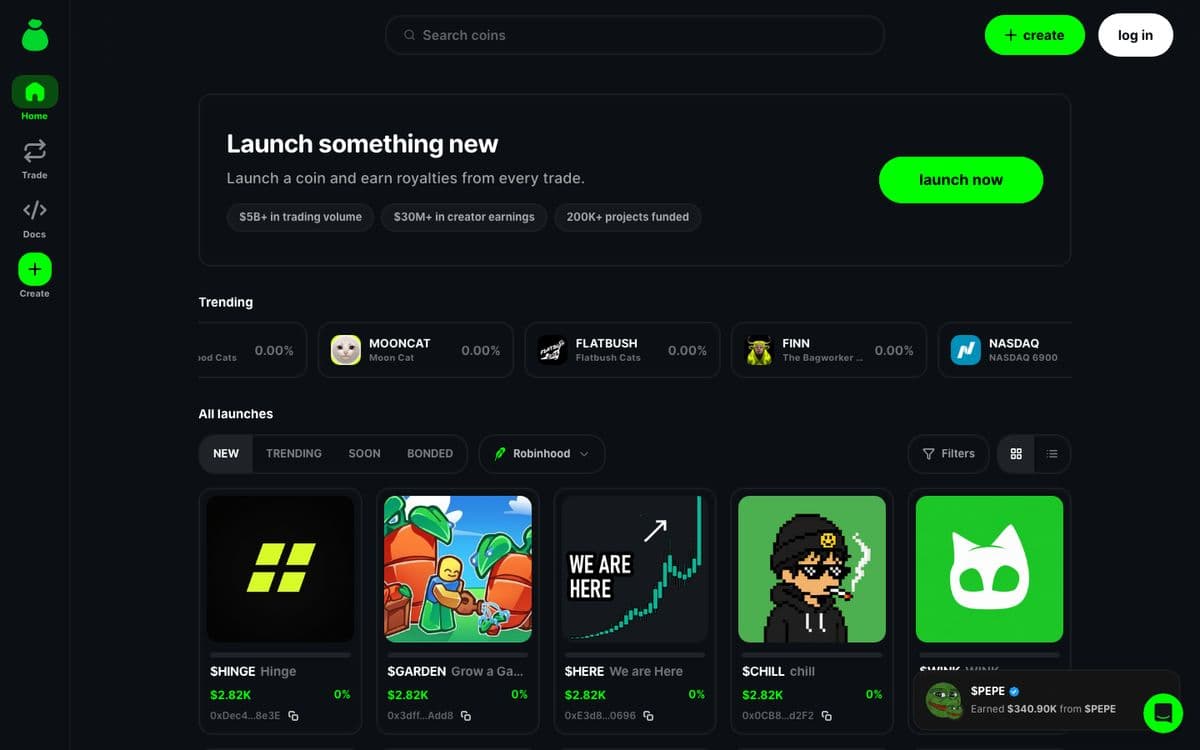
Bags is a memecoin launchpad on Solana and Robinhood Chain. Its homepage says: "Launch a coin and earn royalties from every trade." Each token starts on a bonding curve. A share of every trade goes to a pool of fee claimers that the launcher names before the token goes live.
Fee sharing is required. The Bags changelog says that Token Launch v2 needs a fee-share config for all launches, with up to 100 fee earners per token, the creator included. You name each claimer by an X, Kick or GitHub account. The Bags API then finds the wallet that belongs to that account.
On Solana, Bags uses Meteora's Dynamic Bonding Curve program for the curve and Meteora's DAMM v2 program for the pool after graduation. Its own Fee Share V2 program sets the fee splits and pays out claims. On Robinhood Chain, Bags runs its own contracts and moves graduated tokens to a Uniswap v4 pool. DefiLlama's fee series for Bags starts in May 2025. You can follow the live fees on the Bags stats page.
Is Bags safe and legit?
Bags is a real, working launchpad with public fee rules and public program addresses. On 17 October 2026, DefiLlama's hacks list had no entry for Bags. The risks come from the tokens, from the admin powers in the contracts and from missing audit reports for the Bags programs.
On Solana, the curve and the pool run on Meteora programs. Meteora's audit page lists reports for the Dynamic Bonding Curve program by Offside Labs, OtterSec and Zenith, and reports for DAMM v2 by the same three firms. DefiLlama lists one Meteora DAMM v2 incident on 17 January 2026 and classifies it as social engineering (an impersonation scam). The entry names no flaw in the program code. The Bags program-ID page and the Robinhood Chain contract page link no audit report for the Bags Fee Share program or the Bags contracts.
On Robinhood Chain, the Bags contract reference says that the BagsFactory and the BagsVault are upgradeable proxies. The bonding curve and the fee-share contract of each token are beacon proxies, and only the owner can upgrade them. The vault has owner-controlled withdrawals. The token contract itself cannot be upgraded. The docs do not say if the owner is a multisig, a timelock or one key. Each launch keeps the launch fee and graduation target that applied when it was created.
Custody works in two ways. Traders use their own wallet. Fee claimers who join by social account get a Bags embedded wallet: on Solana the API returns the user's embedded wallet, and on EVM chains the docs name Privy as the wallet provider. The fee-share admin of a token can also change the claimers and their shares after launch, and can transfer the admin role. Before you buy because of a promised fee share, check the current claimer list.
A Bags token can lose all its value. The fee split pays the claimers only while people trade. A completed curve shows only that buyers paid the target amount into it.
Bags fees and the seven fee modes
In the default mode, Bags charges 2% on every buy and sell. On the curve, 1% goes to the platform and 1% to the claimers pool. After graduation the fee stays at 2%: 0.75% to the platform, 0.75% to the claimers and 0.5% back into pool liquidity. In new Solana fee-share configs since September 2026, the wallet that pays for the config (the deployer) takes 25% of the claimers pool. The named claimers split the other 75% by the shares set at launch. A partner share, when a launch has one, comes out of the platform half.
The creator picks one of seven modes, and the mode cannot change after the token launches. The low mode charges 0.25% on the curve and 1% after graduation. The high-curve mode charges 1% on the curve and 0.25% after graduation. The high flat mode charges 10% in both phases. Three more modes keep the 2% default fee but change the supply: 85% of supply locked, 96% of supply locked, or a supply of 1,000 tokens. In the 96% locked mode, the fee after graduation falls from 2% to a floor of 0.5% as the market cap grows.
On Robinhood Chain there is one rate: 2% on the ETH leg of every trade, in both phases. Half goes to the token's fee-share contract for the claimers. The other half goes to the protocol, and a launch partner gets 0.25% of volume from that half by default. Network fees are extra on both chains. Read how launchpads make money to compare this model with other launchpads.
Bags fee example on a $100 and a $1,000 trade
A $100 buy on the curve in the default mode pays a $2.00 fee. The platform gets $1.00 and the claimers pool gets $1.00. In a new Solana config, the deployer takes $0.25 of that pool and the named claimers share $0.75.
A $1,000 buy on the curve in the default mode pays $20.00. The platform gets $10.00 and the claimers pool gets $10.00, of which the deployer takes $2.50 and the named claimers share $7.50. If you sell the same amount later at the same price, you pay the same fee again, so a round trip costs about $40.00.
After graduation, the same $1,000 trade in the default mode still pays $20.00. The platform gets $7.50, the claimers get $7.50 and $5.00 goes back into the pool.
The fee mode changes the result a lot. In the low mode, a $1,000 curve buy pays $2.50. In the high flat mode, the same buy pays $100.00. Check the fee of each token before you buy.
How launching and graduation work
Since September 2025, Bags charges no fee to create a token through its API on Solana. Only Solana transaction costs apply. Robinhood Chain charges a launch fee of 0.02 ETH by default. Bags also publishes a command-line tool and launch intent links that open a pre-filled launch form.
Each Solana token trades on its curve until the curve raises the target for its mode. Most modes graduate at 85 SOL. The 85% locked mode graduates at about 100 SOL and the 96% locked mode at 80 SOL. The token then moves to a Meteora DAMM v2 pool, where part of each fee goes back into liquidity. Our guide to memecoin graduation explains what changes for traders after this step.
On Robinhood Chain, each token has a supply of 1 billion, and 830 million sell on the curve. When the curve reaches the ETH target set in the contract, the remaining 170 million tokens and the full raise go into a Uniswap v4 pool. The liquidity is locked, and the curve stops. For the curve mechanics, read how a bonding curve works.
Who should use Bags?
Bags suits a creator who launches with other people. A streamer can give a share to a co-host, a developer can pay contributors by GitHub account, and a tribute token can pay the person who inspired it. The split is set on chain, so no one has to send payments by hand.
Bags also suits developers. The public API covers launches, fee-share configs, claims and trades, and the docs list every program ID and contract address.
Bags suits frequent traders less well. In the default mode a trader pays 2% on each buy and each sell, and that fee does not fall after graduation. Before you buy a Bags token, check its fee mode and its claimer list. Our guide to creator fees compares how other launchpads pay creators.
Bags vs pump.fun
pump.fun is the closest alternative on Solana. The pump.fun curve fee is 1.25%, of which the creator gets 0.30%. From 17 October 2026, a trade in the pump.fun web or mobile app adds a 0.45% app fee, or 0.40% with a referral code. A $1,000 curve buy therefore costs $17.00 in the pump.fun app, or $16.50 in the app with a code. In pump.fun Terminal or another app, the pump.fun fee is 1.25% ($12.50), plus the fee that app charges. The same buy costs $20.00 on a default Bags token.
The creator side shows the opposite result. On that $1,000 buy, the pump.fun creator gets $3.00. On Bags, the claimers pool gets $10.00, and Bags lets the creator share it with up to 100 accounts. A Bags creator can also choose the 0.25% mode, which makes a $1,000 curve buy cost $2.50 in Bags fees.
See pump.fun vs Bags for the live fee totals side by side. For other Solana options, read Bags vs Believe and LetsBONK vs Bags. Bags vs Zora compares the fee split with Zora, which also runs on Robinhood Chain.
Believe, another Solana launchpad that settles on Meteora, is not a like-for-like choice today: its website does not load, and Believe's current creator-payout terms are unverified. Our Believe review has the details.
The Bags invite link
Bags has invite links that open an invite page for a named user. We opened our link on 17 October 2026. The page title reads "@repeatedbirthmark720 sent you an invite", and the page says that every trade earns the creator 1%. The page names no reward for the person who joins. We found no Bags terms that give a discount or bonus to an invited user, so we list the link only as a way to join Bags. The Bags invite link page has the link.
Referral link. We may earn a commission when you sign up through it. Bags referral terms.
Bags fee table
| Cost | Amount | Note |
|---|---|---|
| Token launch | Solana: no Bags fee through the API. Robinhood Chain: 0.02 ETH by default | Solana transaction costs apply. The Robinhood Chain fee is a contract setting that the owner can change for new launches. |
| Curve fee, default mode | 2% of each buy and sell | 1% to the platform and 1% to the claimers pool. |
| Pool fee after graduation, default mode | 2% of each buy and sell | 0.75% to the platform, 0.75% to the claimers and 0.5% back into pool liquidity. |
| Other Solana modes | 0.25%, 1% or 10% on the curve | The mode is set before launch and cannot change after. |
| Deployer share | 25% of the claimers pool | New Solana fee-share configs since September 2026. |
| Graduation point | 85 SOL in most modes | About 100 SOL in the 85% locked mode and 80 SOL in the 96% locked mode. Robinhood Chain uses an ETH target set in the contract. |
| Robinhood Chain trade fee | 2% on the ETH leg, both phases | Half to the claimers. A launch partner gets 0.25% of volume by default from the protocol half. |
Sources: Bags docs (docs.bags.fm: customize-token-fees, changelog, principles/program-ids, robinhood/overview, robinhood/contracts, api-reference/get-fee-share-wallet and fee-share admin endpoints), the Bags homepage and invite page (bags.fm), Meteora audit pages (docs.meteora.ag/resources/audits/dbc and /damm-v2) and the DefiLlama hacks list (api.llama.fi/hacks). All checked on 17 October 2026. pump.fun rates: pump.fun/docs/fees, checked on 17 October 2026.
Bags fees compared
| Launchpad | Platform fee terms | Launch cost | Chains | Fees, last 30 days |
|---|---|---|---|---|
| Bags | Solana default mode: 2% per trade, half to the platform and half to fee claimers; six other modes set other rates. Robinhood Chain: a flat 2% on the ETH leg. | Solana: no Bags fee for API launches, only transaction costs. Robinhood Chain: 0.02 ETH by default. | Solana, Robinhood Chain | $385.6K |
| pump.fun | 1.25% bonding-curve trading fee before any app fee, including a 0.30% creator fee. From 17 October 2026, trades in the pump.fun web and mobile app add a 0.45% app fee (0.40% with a referral code); pump.fun Terminal and other apps do not charge it, but they charge their own trading fee. PumpSwap canonical-pool fees vary with market cap and quote asset; network fees are separate. | No platform launch fee; network fees apply | Solana | $44.04M |
| Believe | Current trading fees and fee splits are not independently verified. Review the applicable terms and full trade quote before signing. | Current token-launch costs are not independently verified; review the creation quote | Solana | $67 |
| LetsBONK.fun | A curve trade pays 1.5%: a 1.25% LetsBONK fee plus Raydium's 0.25% protocol fee. The revenue dashboard allocates 51% of platform revenue to BONK purchases for the BNKK treasury, not to burning those tokens. | Network and account costs apply; review the launch quote | Solana | $2.95M |
Fee terms: each platform's own docs, as listed in the MemeFees launchpad registry. Fees, last 30 days: DefiLlama, the fees each platform collected, not a rate per trade. “Not tracked” means DefiLlama reports no figure for that platform. Fetched .
Bags data pages
Daily figures for Bags by closed UTC day, with sources and CSV downloads.
Frequently asked questions
Is Bags safe?
Bags is a working launchpad with public fee rules and program addresses, and DefiLlama's hacks list had no Bags entry on 17 October 2026. Its Solana curve and pool run on audited Meteora programs. We found no audit report for the Bags fee-share program or its Robinhood Chain contracts, and the Robinhood Chain factory and vault are upgradeable.
What are the fees on Bags?
In the default mode, Bags charges 2% on every trade, before and after graduation. On the curve, 1% goes to the platform and 1% to the fee claimers. Other modes charge 0.25%, 1% or 10% on the curve.
How much does a $1,000 trade cost on Bags?
A $1,000 trade on a default-mode Bags token costs $20.00. In the low mode it costs $2.50 on the curve, and in the high flat mode it costs $100.00.
Is Bags free to use?
Creating a token through the Bags API on Solana has no Bags fee, only transaction costs. Robinhood Chain charges 0.02 ETH by default. Every trade pays the fee of the token's mode.
How does the creator fee split work on Bags?
Half of each non-compounded fee goes to the claimers pool. In new Solana configs, the deployer takes 25% of that pool, and the claimers named at launch split the rest. A launch can name up to 100 fee earners, the creator included.
Can a Bags creator change the fee split after launch?
The fee mode cannot change after launch. The fee-share admin can change the claimers and their shares, and can transfer the admin role to another wallet.
Is Bags cheaper than pump.fun?
Not in the default mode. Bags charges 2% on the curve. pump.fun charges 1.70% in the pump.fun app, and 1.25% plus the app's own fee in other apps. A Bags token in the 0.25% mode has a lower curve fee than pump.fun.
Does the Bags invite link give a reward?
We found no Bags terms that give a reward to a user who joins through an invite link. The link opens the Bags invite page.
Sign up for Bags
We found no published benefit for a new user who joins Bags with this link.
Referral link. We may earn a commission when you sign up through it. Bags referral terms.
Related
How we checked
- Facts checked
- . On that date we compared the facts on this page with the sources below.
- Data refreshed
- . The fee figures come from DefiLlama and update without a new review. Bags live statistics.
- Primary sources
- Not tested
- We did not place trades, deposits or withdrawals on Bags for this review.
We are independent and not affiliated with Bags. The activity figures give context. They do not measure execution quality or safety. Read our methodology.
Memecoins can lose their entire value. This page gives general information. It is not financial advice.