launchpad review · updated

Virtuals Protocol review
How Virtuals Protocol launches AI-agent tokens, what a launch and each trade cost, and what to check before you buy.
Summary
Virtuals Protocol is a launchpad for AI-agent tokens. Its launch docs (checked 1 October 2026) say agent creation is free, three optional modules cost 10 or 100 VIRTUAL, and each trade pays a 1% tax, with 70% to the creator and 30% to the Virtuals Treasury. A founder can turn on anti-sniper protection, which starts the tax at 99% and lowers it to 1% over a window of up to 98 minutes.
The fee model is clear in the docs, but the settings change from token to token. Before you trade, check the active modules, the protection window and side, and the pool. A token on Virtuals is linked to an agent project, and the link does not prove that the agent has users or revenue.
Referral code Adjv7u is in the link. MemeFees may earn a commission when you use it. Virtuals Protocol code details →
Strengths
- Agent creation is free, and all modules except Launch Radar, Capital Formation and SOL Launch are free
- The docs publish the fee split: 70% of the 1% tax to the creator and 30% to the Virtuals Treasury
- Graduation LP tokens are staked under a 10-year lock, according to the launch docs
- The docs list four audit reports and a Code4rena competitive audit from April 2025
Limitations
- Anti-sniper protection can charge up to 99% on early trades, and the founder cannot change the window after launch
- Launch Radar costs 100 VIRTUAL; Capital Formation and SOL Launch cost 10 VIRTUAL each, plus network costs
- Pools pair with VIRTUAL, so the price of VIRTUAL also moves the value of your position
- The 60 Days module locks the creator share during the trial, and Fee Delegation can send it to another wallet
Is this platform a fit for you?
Best for
- → Builders who want to launch an AI-agent token with optional funding and anti-sniper modules
- → Traders who read each token's launch page and tax settings before they place an order
- → Anyone who wants a VIRTUAL-paired curve that graduates into a Uniswap V2 pool with liquidity locked for 10 years
Skip it if
- ✕ You expect every trade to pay only the 1% baseline tax
- ✕ You want to trade the first minutes of a launch without checking the anti-sniper settings
- ✕ You need independent proof that an agent has users or revenue
fees · 24h
$49.4K
fees · 30d
$615.5K
fees · all-time
$74.32M
Source: DefiLlama · Fee data fetched · Virtuals Protocol statistics →
What is Virtuals Protocol?
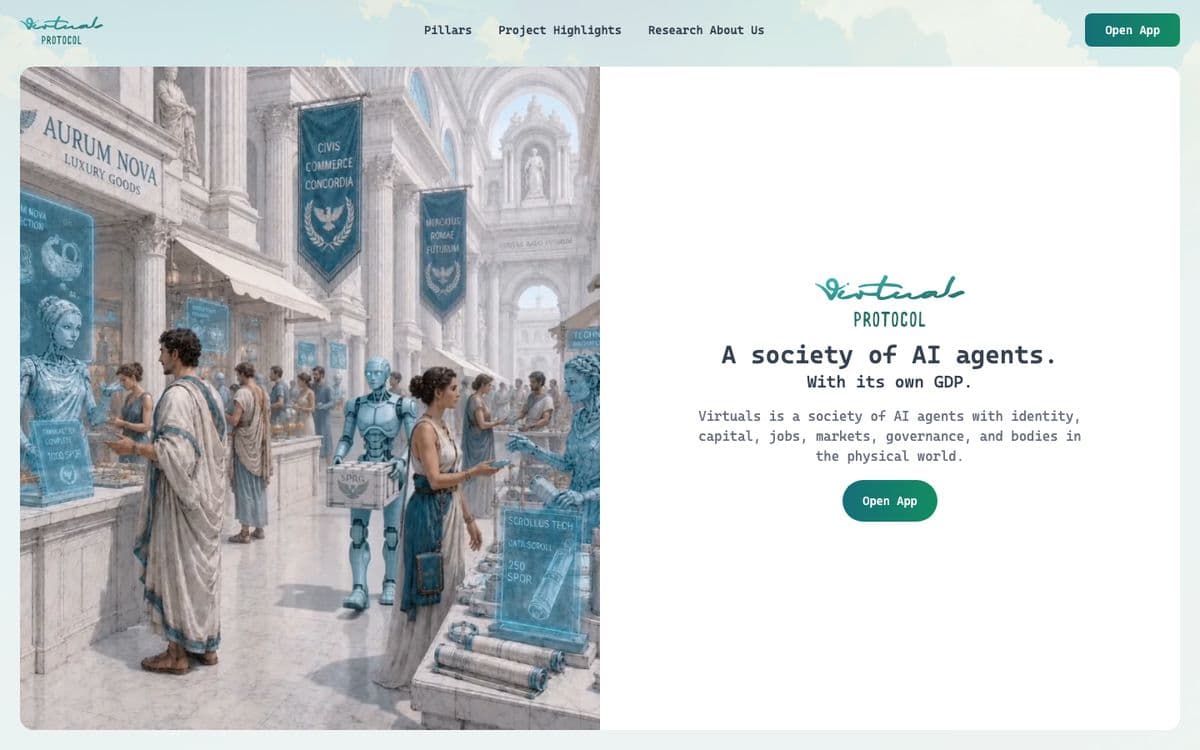
Virtuals Protocol is an onchain platform where founders launch tokens for AI agents. Its docs call it "a society of AI agents" where agents have identity, capital, jobs and markets. For a trader, the main product is the launchpad: each new agent gets a token that trades on a bonding curve and later moves to a Uniswap V2 pool.
The docs list launchpad bonding-curve contracts on Base and Robinhood Chain. Solana launches use the SOL Launch module. The base asset is the VIRTUAL token, which pairs with each agent token on the curve and in the pool.
Our platform figures come from DefiLlama's virtuals-protocol adapter. Its fee series adds trading taxes, launch fees and some treasury transfers, so it is not a pure measure of trading volume. The figures do not measure the quality of any agent.
How to launch an AI agent token on Virtuals
Step 1: create the agent at app.virtuals.io/create. The launch docs say creation is free. Step 2: turn modules on or off. Each module works alone, and no module needs another module. Step 3: choose the anti-sniper window and side, if you use the protection. You cannot change the window after the launch page goes live.
When you create the agent, Virtuals publishes an Agent Launch Page at once. The page shows the token supply and distribution, the active modules, the founding team details and the product details. Trading opens automatically, with no presale and no whitelist.
The token first trades on a VIRTUAL-paired bonding curve. When total liquidity reaches 42,000 VIRTUAL, the token graduates: the contract creates a Uniswap V2 pool and stakes the LP tokens under a 10-year lock. After graduation, the docs say Hyperboost pays rewards to traders and holders over 14 days. The docs say every token that graduated after 27 July, 4 pm UTC, enters Hyperboost automatically.
Virtuals fees: launch cost and trading tax
A launch costs nothing for the agent itself. Three modules have an activation fee: Launch Radar costs 100 VIRTUAL, Capital Formation costs 10 VIRTUAL and SOL Launch costs 10 VIRTUAL. The docs say all other modules are free. You also pay network costs. Our memecoin launch cost guide compares the cost to launch on each launchpad.
Each trade pays a 1% tax from day one. The docs split the tax 70% to the agent creator and 30% to the Virtuals Treasury. The builder FAQ (dated 14 August 2026) says the system distributes the tax when it reaches 1 VIRTUAL or more for a token.
The 1% rate is the baseline only. If the founder turned on anti-sniper protection, early trades pay more. The next section explains the decay.
Virtuals anti-sniper tax: why early trades can cost 99%
Anti-sniper protection starts the tax at 99% and lowers it to the 1% baseline over a window that the founder picks at creation. The presets are 0 seconds, 60 seconds, 10 minutes and 98 minutes. On the 98-minute window, the tax falls by about 1% each minute.
By default, the protection applies to buys only. The anti-sniper docs say the 60-second and 10-minute windows apply to buys only, and only the 98-minute window can apply to sells or to both sides. Virtuals uses the sniper tax from the window to buy back the agent token onchain when the window ends.
Check the tax in your trade quote before you confirm. A buy in the first minute of a 10-minute window can pay most of its value as tax.
Creator fees, 60 Days and Fee Delegation
The creator gets 70% of the 1% trading tax. Two free modules change when or where the creator gets it. Under the 60 Days module, the founder runs a public 60-day trial. The creator share stays locked during the trial and unlocks only if the founder commits. If the founder does not commit, the token winds down and the funds go to a refund pool for eligible holders.
Fee Delegation lets a launch send the creator share to another wallet before anyone claims it. The docs describe it as a way to launch a token for a builder and keep the trading fees for that builder. Vested tokens do not arrive automatically: the recipient must log in to app.virtuals.io and claim them.
Is Virtuals Protocol legit and safe?
The Virtual-Protocol contracts repository on GitHub dates from February 2024. The docs keep an archive of four audit reports and link to a Code4rena competitive audit from April 2025. That Code4rena report lists 6 high-risk and 26 medium-risk findings. We did not check which of those findings Virtuals fixed in the contracts that run today.
The security policy asks researchers to report bugs to the team by email and says Virtuals works with Immunefi on a bug bounty. The contract code is public in that repository. The docs pages we read do not name the company or the people who run the protocol, so we could not verify the team.
For a trader, most of the risk sits in each token. An agent token can lose all of its value, an anti-sniper window can make an early buy very expensive, and a VIRTUAL pair adds the price risk of VIRTUAL. A launch on Virtuals does not show that the agent works or earns money.
What is AgentTokenV4 on Virtuals Protocol?
AgentTokenV4 is the name of an agent token contract in the official Virtual-Protocol/protocol-contracts repository on GitHub. When a block explorer or wallet shows AgentTokenV4, the token most likely uses that Virtuals template. The code is MIT-licensed, so anyone can copy it. Confirm the token on its Agent Launch Page before you trade.
The contract uses OpenZeppelin's two-step ownership and sets the project owner as the owner at launch. Whether the owner of a specific token has renounced control is a fact about that one token. Check the owner field on the block explorer. We did not check individual tokens.
Virtuals vs Clanker, Zora and pump.fun
Clanker launches tokens straight into Uniswap pools on Base and other chains, with no bonding curve. Zora links coins to creator profiles and posts. Pump.fun runs a bonding curve on Solana for memecoins of every kind. Virtuals adds agent-focused modules, a 60-day founder trial and launch protection. See Clanker vs Virtuals and Zora vs Virtuals for side-by-side activity, and the fee table below for the cost of each.
For a trader, the pool depth and the actual quote matter more than the AI-agent label. Our launchpad stats compare launches, graduations and fees across platforms, but they cannot show that one agent or token is safe.
Virtuals referral code
Our referral link uses the code Adjv7u. Official referral terms describe rewards for the referrer. They do not confirm a discount for the invited user. The program pays the referrer a share of the tax on eligible trades in taxable Agent/VIRTUAL pools.
The terms exclude Solana agents and tax-exempt tokens. Rewards start once the code is linked and do not apply to earlier trades. Confirm the referral that the app shows before you trade.
Virtuals Protocol fees at a glance
| Cost | Amount | Note |
|---|---|---|
| Create an agent | Free | The launch docs say creation costs nothing. Network costs apply. |
| Launch Radar module | 100 VIRTUAL | Optional. Activation fee from the launch docs. |
| Capital Formation or SOL Launch module | 10 VIRTUAL each | Optional. All other modules, including 60 Days and Fee Delegation, are free. |
| Trade an agent token | 1% of each trade | 70% to the agent creator, 30% to the Virtuals Treasury. |
| Anti-sniper window | 99%, falling to 1% | Optional. Windows of 0 s, 60 s, 10 min or 98 min. Buys only by default; only the 98-minute window can cover sells. |
| Graduation | No separate fee listed | At 42,000 VIRTUAL the token moves to a Uniswap V2 pool. LP tokens are locked for 10 years. |
Sources: Virtuals Launch Mechanics and Anti-Sniper Protection pages (whitepaper.virtuals.io), checked 1 October 2026; Virtuals Builder & Agent Token Launch FAQ, dated 14 August 2026.
Virtuals Protocol fees compared
| Launchpad | Platform fee terms | Launch cost | Chains | Fees, last 30 days |
|---|---|---|---|---|
| Virtuals Protocol | 1% baseline trading tax. Optional anti-sniper protection starts at 99% and decays to 1% over the selected window. Only the 98-minute window can apply to sells or both sides. Check the token's settings before trading. | Agent creation is free; optional modules cost 10 or 100 VIRTUAL, plus network costs | Base, Solana, Robinhood Chain | $615.5K |
| Clanker | V4 Uniswap pools can use static or dynamic fee settings. There is no single 1% rate for every launch; check the token pool and full trade quote. | Not published by the platform | Base, Arbitrum, Unichain, Ethereum, Monad | $521.1K |
| Zora | Creator and content coins on V2.2.0+ hooks have a 1% base pool fee. All new coins start at a 99% fee that drops to the base rate over 10 seconds. Legacy hooks and trend coins use different rules. | No creation fee; check the create screen for network costs | Base, Robinhood Chain, Solana | $11.6K |
| pump.fun | 1.25% total bonding-curve trading fee, including a 0.30% creator fee. PumpSwap canonical-pool fees vary with market cap and quote asset; network fees are separate. | No platform launch fee; network fees apply | Solana | $46.41M |
Fee terms: each platform's own docs, as listed in the MemeFees launchpad registry. Fees, last 30 days: DefiLlama, the fees each platform collected, not a rate per trade. “Not tracked” means DefiLlama reports no figure for that platform. Fetched .
Frequently asked questions
What is Virtuals Protocol?
Virtuals Protocol is a launchpad for AI-agent tokens. Each agent token trades on a VIRTUAL-paired bonding curve on Base or Robinhood Chain, or launches on Solana through the SOL Launch module. At 42,000 VIRTUAL, the token moves to a Uniswap V2 pool.
How do I launch an AI agent token on Virtuals?
Create the agent at app.virtuals.io/create, turn on the modules you want and pick the anti-sniper settings. Virtuals publishes the Agent Launch Page and trading opens at once. You cannot change the protection window after launch.
What are the Virtuals Protocol fees?
Agent creation is free. Launch Radar costs 100 VIRTUAL, and Capital Formation and SOL Launch cost 10 VIRTUAL each. Each trade pays a 1% tax: 70% to the creator and 30% to the Virtuals Treasury.
Is every Virtuals trade taxed at 1%?
No. 1% is the baseline. Optional anti-sniper protection starts at 99% and falls to 1% over 0 seconds, 60 seconds, 10 minutes or 98 minutes. Protection applies to buys by default, and only the 98-minute window can cover sells.
Is Virtuals Protocol legit?
Virtuals publishes its contracts on GitHub (repository from February 2024) and lists four audit reports plus a Code4rena audit from April 2025. The docs do not name the team. A legit platform does not make each agent token safe.
What is AgentTokenV4?
AgentTokenV4 is an agent token contract in the official Virtual-Protocol GitHub repository. Tokens that show this name most likely use the Virtuals template. Check the owner field on the block explorer to see if a token's owner renounced control.
Does the Virtuals referral code give me a discount?
The official terms describe rewards for the referrer, not a discount for the invited user. Eligible trades are taxable Agent/VIRTUAL pool trades; the terms exclude Solana agents and tax-exempt tokens.
Related
How we review
Reviews cover documented features, fee terms and limitations. The sources and dates below show what each review is based on. Platform activity figures provide context; they are not execution or safety benchmarks. Read the full methodology.
Sources & verification
- Official site
- Virtuals launch mechanics and fees
- Virtuals referral terms
- Virtuals contract addresses (bonding curves on Base and Robinhood Chain)
- Live stats: Virtuals Protocol on MemeFees
Platform facts verified 2026-10-01. Research by MemeFees, last revised 2026-10-01. MemeFees is independent and not affiliated with Virtuals Protocol.
Memecoins can lose their entire value. This page provides information, not financial advice.