launchpad review · updated

Pons review
Pons V1 and V2 compared on launch mechanics, fee terms, creator payouts and data coverage on Robinhood Chain.
Summary
Pons is a token launchpad on Robinhood Chain. V1 tokens trade in a locked pool from launch, with graduation used as a milestone label. V2 starts on a bonding curve and graduates into a locked Uniswap v4 pool.
The two versions have different fee and payout rules. Current V2 documentation also restricts public launches to approved addresses while security reviews remain in progress. Read the version-specific terms before launching or trading.
Strengths
- V1 tokens trade in a locked pool immediately without filling a bonding curve
- The V1 launch fee is published as 0.0005 ETH
- V1 documentation distinguishes current-factory and legacy creator fee splits
- V2 supports approved pairing assets, with creator payouts in that asset
- Both versions publish contract and mechanism documentation
Limitations
- Pons launched in July 2026
- V2 audit reports are not yet published according to the current documentation
- Pons has no referral program, so no code lowers its fees
- Fee and volume adapters cover different product scopes; the totals are not interchangeable
Is this platform a fit for you?
Best for
- → Creators comparing immediate pool trading in V1 with a curve-based V2 launch
- → Readers researching Robinhood Chain token-launch mechanics
- → Creators comparing fee distributions and payout currencies
Skip it if
- ✕ You need operating history from before July 2026
- ✕ You require completed, published V2 audit reports before using a protocol
- ✕ You need unrestricted public V2 token creation; the current docs describe an approval requirement
fees · 24h
$1.07M
fees · 30d
$123.97M
fees · all-time
$188.13M
Source: DefiLlama · Fee data fetched · Pons statistics →
What Pons is
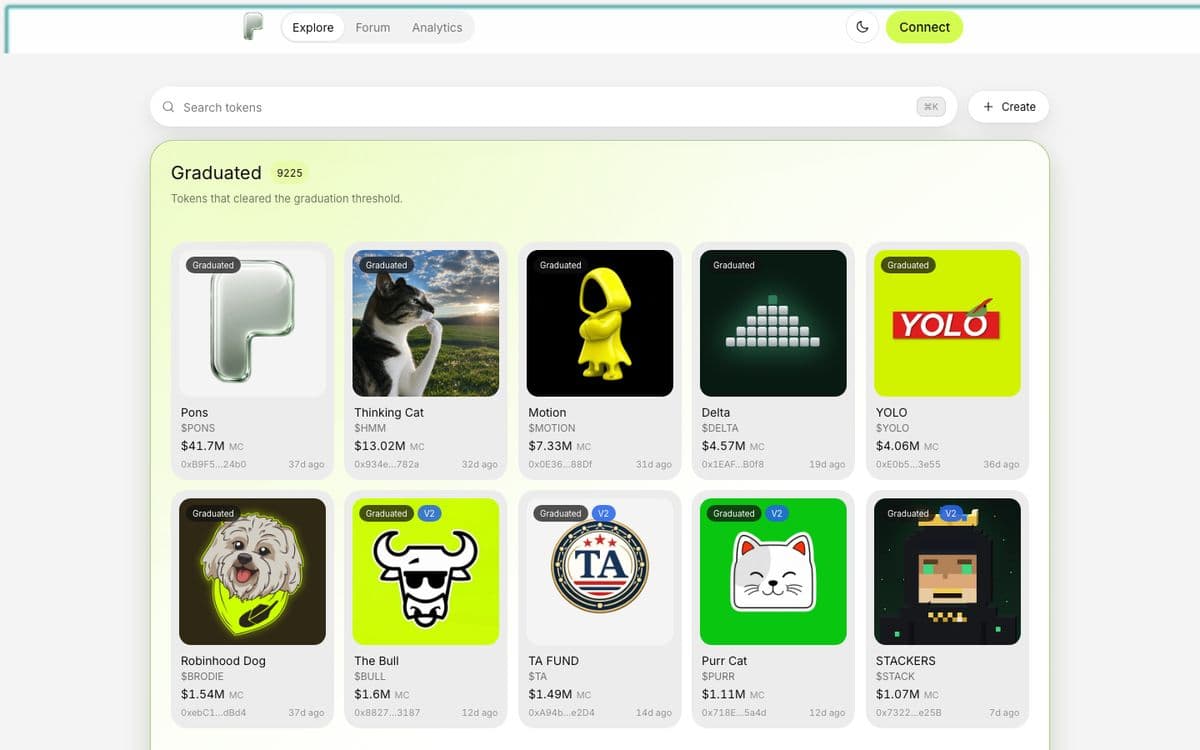
Pons runs two launch models on Robinhood Chain. V1 creates a locked pool immediately; V2 begins with a bonding curve. MemeFees combines the V1 and V2 fee adapters, but its volume figure covers V2 launch-curve swaps only and excludes V1 and external Uniswap v4 swaps.
How V1 works: no curve, locked pools from block one
A V1 token deploys straight into a Uniswap pool with liquidity that is permanently locked. There is no bonding curve to fill and no separate migration step. Buys are limited for the first two blocks: on the launch block only the creator's first buy can run, and then each wallet can hold at most 5% of supply and buy at most 5.5%.
Pons labels 4.2 ETH of paired liquidity as graduation, but the label does not change where the token trades. A V1 token stays in the same pool before and after that milestone.
V2: a real launch curve on Uniswap v4
V2 sells a configured token allocation on a bonding curve, then creates a locked Uniswap v4 pool. The target is denominated in the chosen pairing asset; the V1 default of 4.2 ETH should not be treated as a universal V2 threshold.
Approved quote assets can replace ETH throughout the launch. Trades and creator payouts use that pairing asset. The current docs say new V2 launches require approval and that independent security reviews are still in progress.
Fees and creator rewards
V1 charges a 1% pool fee. Current-factory tokens split that fee 70% to the creator and 30% to the protocol; legacy tokens retain their original 90% / 10% split. V1 lists a 0.0005 ETH creation fee.
V2 combines a token-specific base fee with any creator tax set at launch. V2 buys also pay a snipe tax that starts at 99% and falls to zero over the first 5 seconds; sells never pay it. The creator's payout and optional buyback allocation follow that launch's configuration. Check the current launch fee and trade quote instead of applying the V1 schedule to V2.
On 29 September 2026, Robinhood said that swaps over $0.50 in Robinhood Wallet on Robinhood Chain have no gas fee until 31 December 2026. The offer names Robinhood Wallet only. Robinhood does not say if trades on Pons qualify, and other wallets pay normal network fees.
Risks and limitations
V2 documentation says audit engagements are in progress and public creation is restricted to approved addresses. A published source or locked pool does not establish that a token is safe or liquid.
Reported fee totals combine the two DefiLlama adapters, while volume covers only V2 launch curves. Historical adapter labels can refer to different deployment generations from the current documentation.
How it compares
Pons competes directly with other Robinhood Chain launchpads that appeared within weeks of it. Pools, built by Uniswap Labs, charges no launchpad fee, and its pools charge a 0.25% LP fee. On LetsCash, the creator chooses a trading tax of 1%, 3%, 5% or 10% at launch, and the platform keeps 0.3% of each trade. NOXA arrived on Robinhood Chain first and now launches tokens there through a new contract. See Pons vs Pools, Pons vs LetsCash and Pons vs NOXA for the numbers side by side.
pump.fun is a launchpad on Solana, and Pons is a younger platform on a different chain. See pump.fun vs Pons for a direct comparison.
Pons data pages
Daily figures for Pons by closed UTC day, with sources and CSV downloads.
Frequently asked questions
Does Pons have a bonding curve?
V1 trades directly in a locked pool. V2 starts with a bonding curve and then creates a locked Uniswap v4 pool.
What does graduation mean on Pons?
V1 uses a default 4.2 ETH paired-liquidity milestone and keeps trading in the same pool. V2 graduates when its configured curve allocation sells out, creating a pool paired against that launch’s selected asset.
How much does it cost to launch on Pons?
V1 lists a 0.0005 ETH creation fee and a 1% pool trading fee. V2 uses its current factory launch fee and token-specific trading terms; check the quote and creation eligibility.
Does Pons have a referral program?
No. Pons has no referral program. Its documentation covers creator fees and launch costs only.
Related
How we review
Reviews cover documented features, fee terms and limitations. The sources and dates below show what each review is based on. Platform activity figures provide context; they are not execution or safety benchmarks. Read the full methodology.
Sources & verification
- Official site
- Pons V1 documentation
- Pons V2 documentation and availability
- Live stats: Pons on MemeFees
Platform facts verified 2026-10-01. Research by MemeFees, last revised 2026-10-01. MemeFees is independent and not affiliated with Pons.
Memecoins can lose their entire value. This page provides information, not financial advice.