
LetsCash review
The CASHCAT community's launchpad on Robinhood Chain. We checked its creator-set tax, locked pools and safety record against the LetsCash docs on 17 October 2026.
Facts checked . How we checked
Our verdict
LetsCash is a working launchpad on Robinhood Chain from the community behind CASHCAT. One transaction deploys the token, seeds a Uniswap v4 pool with the whole supply and locks the liquidity forever. There is no bonding curve and no migration. Each trade pays a tax of 1%, 3%, 5% or 10% that the creator picks at launch, and the platform keeps 0.3% of the trade at every rate.
The design closes the liquidity-pull rug, and a contract that cannot be upgraded caps the tax at 10%. The weak points are the age of the platform, which went live on 29 July 2026, and the lack of a published audit report. Check the tax on the token page before you buy: a 10% coin costs ten times as much to trade as a 1% coin.
Fees: Creator-chosen trading tax of 1%, 3%, 5% or 10% in ETH or USDG. The platform keeps 0.3% of each trade at every rate; a quarter of that buys and burns CASHCAT.
Best for
- Creators who want to set their own tax and take 0.7% to 9.7% of every trade
- Creators who want a coin priced in dollars, since a pool can trade against USDG instead of ETH
- Traders who want a token in its final pool from the first second, with no curve and no migration
Skip it if
- You trade often on 3%, 5% or 10% coins. The tax applies to every buy and every sell
- You want an audited platform. We found no published audit report for LetsCash
- You want a referral discount. LetsCash publishes no referral terms, and MemeFees holds no LetsCash code
Strengths
- Launch, pool, liquidity lock and first buy happen in one transaction, so nobody can trade before the creator
- The hook contract rejects every liquidity withdrawal, and the docs say no upgrade can change that
- The tax ceiling of 10% sits in a contract that cannot be upgraded
- Fees are paid in ETH or USDG, never in the memecoin, so nobody has to sell the coin to get paid
- A quarter of the 0.3% platform cut buys and burns CASHCAT, and anyone can trigger the burn
Limitations
- Every trade pays at least 1%, because the lowest tax is 1% and self-burn coins pay a flat 1%
- LetsCash went live on 29 July 2026, so it has a short record
- KuCoin News reported audits in progress in July 2026, but we found no published report
- The site warned on 17 October 2026 that slow Robinhood Chain nodes can make a trade, claim or launch fail to send
- The factory contract is upgradeable behind a proxy, although the docs say it holds no funds
fees · 24h
$127
fees · 30d
$54.4K
fees · all-time
$2.71M
Source: DefiLlama · Fee data fetched · LetsCash statistics →
What is LetsCash?
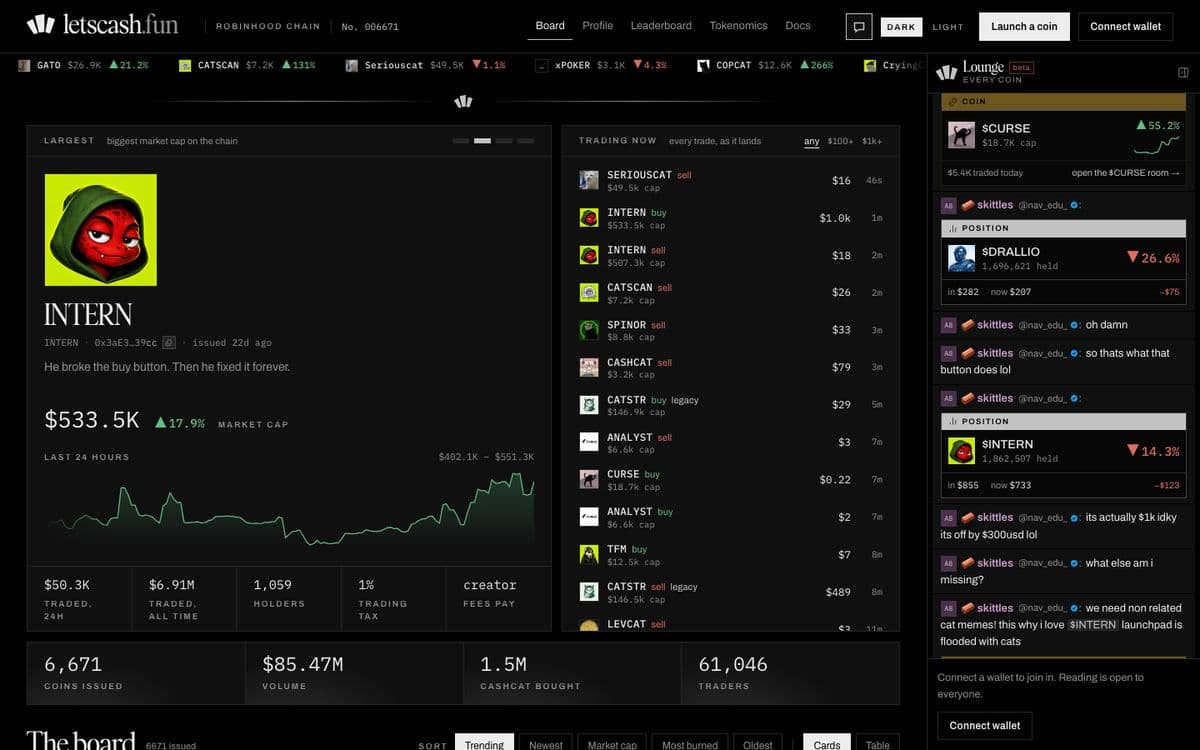
LetsCash is a memecoin launchpad on Robinhood Chain at letscash.fun. The community behind CASHCAT built it, and CASHCAT itself first launched on the NOXA launchpad. KuCoin News reported the launch of letscash.fun on 29 July 2026.
Each LetsCash token is born inside its own Uniswap v4 pool. One factory transaction deploys a fixed-supply ERC-20 token, creates and seeds the pool with the entire supply, locks the liquidity and runs the creator's first buy. The pool trades against ETH or USDG, a dollar stablecoin, and the creator picks one at launch. Every LetsCash token address ends in "cc".
The site says that a new pool opens at a market cap of a few thousand dollars. Because the pool is the market from the first trade, any terminal, bot or aggregator on Robinhood Chain can trade the coin without a special integration. Coins from the first beta still trade on legacy.letscash.fun, on the first build of the contracts. You can follow LetsCash fees on the LetsCash stats page.
Is LetsCash safe and legit?
LetsCash is a working launchpad with on-chain rules that a trader can check, but it has a short record and no published audit. You trade from your own wallet, and the platform never holds your funds. The contracts are verified on the Robinhood Chain explorer, according to the LetsCash about page.
The liquidity lock is the main safety feature. The hook contract runs inside every swap and rejects every attempt to remove pool liquidity. The docs say that the hook is immutable and that no upgrade, including one by the LetsCash team, can change the lock. A creator cannot pull the pool. A creator can still sell the tokens from the first buy, so check how much the creator bought.
The tax ceiling is also in the hook. The docs say that the old ceiling was 90%, in a contract that could be upgraded, and that the current ceiling of 10% cannot be raised by anyone. The factory, the contract that launches tokens, is upgradeable behind a proxy so that new launch modes can ship. The docs say that the factory holds no funds and has no power over tokens already launched.
On 29 July 2026, KuCoin News reported that letscash.fun was in final security audits with Hyacinth Audits and SB Security. We found no published report from either firm, and DefiLlama lists zero audits for LetsCash. We found no report of an exploit. On 17 October 2026, the site showed a notice that the Robinhood Chain nodes it reads from were degraded. The notice says that coins and balances are safe, but a trade, claim or launch may fail to send. A failed send did not happen, so try it again later.
The coins are the larger risk. The site footer says that memecoins can go to zero, and a thin pool moves hard in both directions. A locked pool does not stop a price crash.
LetsCash fees and the launch tax
Each LetsCash trade pays the tax that the creator chose at launch: 1%, 3%, 5% or 10%. The about page says that 1% is the default. The hook takes the tax inside the swap, on buys and sells, in ETH or USDG. Nobody, including LetsCash, can raise the rate after launch, and the token page and card show it.
The platform keeps 0.3% of the trade at every rate. The creator side gets the rest: 0.7%, 2.7%, 4.7% or 9.7% of the trade. In self-burn mode the tax is a flat 1%, the creator earns nothing, and the 0.7% buys the coin on its own pool and destroys it, so the total supply falls.
Launching costs about one dollar in ETH, per the about page. The fee is paid in ETH even for a USDG pool, and it exists to price out spam. Robinhood Chain gas is extra. To see how launchpads earn from fees, read how launchpads make money.
Fee example on a $100 and a $1,000 trade
On a 1% LetsCash coin, a $100 buy pays a $1.00 tax: $0.70 to the creator side and $0.30 to the platform. A $1,000 buy pays $10.00: $7.00 to the creator side and $3.00 to the platform. A round trip, a $1,000 buy and a $1,000 sell, pays $20.00 in tax.
On a 10% coin, the same $100 buy pays $10.00, of which $9.70 goes to the creator side. A $1,000 buy pays $100.00, of which $97.00 goes to the creator side. A round trip at 10% costs $200.00 before price impact. The 3% and 5% rungs fall between: $30.00 and $50.00 on a $1,000 buy.
The same $1,000 buy costs $10.00 on a Pons V1 pool, which charges 1%, and $2.50 on Pools, which charges a 0.25% pool fee on Robinhood Chain. A 1% LetsCash coin costs the same as Pons V1. A higher LetsCash tax pays the creator more and gives traders a reason to trade another coin.
Where the 0.3% platform cut goes
The platform cut lands in a revenue splitter contract. A quarter buys CASHCAT on the open market and sends it to the dead address. A quarter buys CASHCAT for the treasury. The rest pays for servers, infrastructure and development.
Both CASHCAT buys are public functions that pay a bounty to whoever calls them, so anyone can trigger a burn. On a USDG pool, the platform cut is sold for ETH through a Uniswap v3 route, priced against that route's time-weighted average, before it reaches the treasury. The tokenomics page on letscash.fun shows the burn totals as trades happen.
Creator rewards and fee splits
A creator claims the fee share in the pool's own asset, ETH or USDG, whenever they like. On a standard coin, the fee stream can move to a new address in one call, with any unclaimed fees. The creator can also name a wallet at launch to receive the stream from the start.
A launch can split the creator share between two to four recipients on fixed shares. Nobody can change the shares after launch. Anyone can call the function that pulls fees from the hook and credits each recipient, and each recipient then collects their own balance. One recipient who cannot receive the asset blocks only themselves. Compare these terms with other launchpads in our guide to creator fees.
Airdrop vaults
LetsCash has a beta feature for creator airdrops. A creator can send an agreed share of the first buy into a vault that nobody can withdraw from. Tokens leave the vault only along a recipient list that the creator publishes on chain, after a 5-minute public notice. Anyone can then trigger the payout. If the creator never publishes a list, the vault destroys the tokens after 7 days.
The docs state the limit plainly. The vault proves disclosure, not fairness. A creator can publish a list with one wallet that they own and pay themselves, and the coin page then says so.
Who should use LetsCash?
Creators who want control over their income are the best fit. They pick the tax, the pool asset and the fee recipients, and the contracts hold those choices for good. A USDG pool pays the creator in dollars with no conversion.
Traders who want a coin in its final pool from launch also fit. There is no graduation cliff and no migration day. Traders who buy and sell often should stick to 1% coins, because the tax applies to every trade. Traders who want the lowest fee on Robinhood Chain should look at Pools first.
LetsCash vs Pons and Pools
Pons V1 is the closest alternative. Both launch straight into a pool with no curve, and a Pons V1 pool charges 1% with 70% to the creator under the current factory. A 1% LetsCash coin splits the same way, 0.7% to the creator and 0.3% to the platform. LetsCash adds higher tax rungs, USDG pools and fee splits. Pons V2 adds a curve before the pool. See Pons vs LetsCash for the live numbers.
Pools is the cheapest of the three for traders. Pools charges a 0.25% pool fee on Robinhood Chain and no launch fee, and the creator fee is optional. See LetsCash vs Pools for the side-by-side data. NOXA, where CASHCAT first launched, uses a 1% Uniswap V3 pool fee. The table below compares all four.
Pons publishes separate V1 and V2 fee terms. A V1 token trades in a locked pool with a 1% fee, and the fee on a V2 token depends on its settings. Check which version a Pons token uses before you compare it with a LetsCash coin.
LetsCash referral code
We found no published referral program for LetsCash, and MemeFees holds no LetsCash code. Fee splits pay named recipients a share of the creator side. They give traders no discount.
LetsCash fee table
| Cost | Amount | Note |
|---|---|---|
| Token launch | About one dollar in ETH | Paid in ETH for ETH and USDG pools. Robinhood Chain gas is extra. |
| Trading tax | 1%, 3%, 5% or 10% of each buy and sell | Set at launch. 1% is the default. Nobody can raise it later. |
| Platform cut | 0.3% of each trade | The same at every rate. A quarter buys and burns CASHCAT, a quarter buys CASHCAT for the treasury. |
| Creator share | 0.7%, 2.7%, 4.7% or 9.7% | Paid in ETH or USDG. Can be split between up to four recipients. |
| Self-burn mode | Flat 1% | The 0.7% creator share buys the coin and burns it. The creator earns nothing. |
| Graduation | None | The pool is seeded at launch and the liquidity is locked forever. |
Sources: LetsCash docs (letscash.fun/docs), the LetsCash about page (letscash.fun/about), the LetsCash tokenomics page and legacy site (legacy.letscash.fun), KuCoin News (29 July 2026) and DefiLlama protocol data (api.llama.fi/protocol/letscash). All checked on 17 October 2026.
LetsCash fees compared
| Launchpad | Platform fee terms | Launch cost | Chains | Fees, last 30 days |
|---|---|---|---|---|
| LetsCash | Creator-chosen trading tax of 1%, 3%, 5% or 10% in ETH or USDG. The platform keeps 0.3% of each trade at every rate; a quarter of that buys and burns CASHCAT. | About one dollar in ETH, in one transaction; the tax is set at launch | Robinhood Chain | $54.4K |
| Pons | V1: 1% pool fee; current-factory tokens split it 70% creator / 30% protocol, while legacy tokens retain 90% / 10%. V2: token-specific base fee plus any creator tax; check both in the trade quote. | V1: 0.0005 ETH. V2: check the current factory launch fee and eligibility. | Robinhood Chain | $25.68M |
| Pools | Robinhood Chain: 0.25% pool fee on trades, compounded into locked liquidity. Arc: trading fees buy back and burn the token. No launchpad fee on either chain. | No launchpad fee (network fees only) | Robinhood Chain, Arc | $293.8K |
| NOXA Fun | 1% pool fee on trades. The creator share depends on the operator: the current noxa.fi site splits it 50/50, and the original team set it to 100% for creators in July 2026. | The current noxa.fi site lists no launch fee; the original docs give no amount | MegaETH, Monad, Stable, Robinhood Chain | $544.3K |
Fee terms: each platform's own docs, as listed in the MemeFees launchpad registry. Fees, last 30 days: DefiLlama, the fees each platform collected, not a rate per trade. “Not tracked” means DefiLlama reports no figure for that platform. Fetched .
Frequently asked questions
Is LetsCash safe?
LetsCash locks all pool liquidity in a contract that cannot be upgraded, and it caps the tax at 10%. You trade from your own wallet. We found no published audit report, and the platform went live on 29 July 2026. The coins themselves can go to zero.
What are the LetsCash fees?
Each trade pays the tax that the creator chose: 1%, 3%, 5% or 10%. The platform keeps 0.3% of the trade, and the creator side gets the rest. Launching costs about one dollar in ETH.
How does launching on LetsCash work?
One transaction deploys the token, seeds a Uniswap v4 pool with the whole supply, locks the liquidity and runs the creator's first buy. The creator picks ETH or USDG as the pool asset.
Can a LetsCash creator pull the liquidity?
No. The hook contract rejects every liquidity withdrawal, and the docs say that no upgrade can change that. The creator can still sell the tokens from the first buy.
What is self-burn mode?
A self-burn coin pays a flat 1% tax. The platform keeps 0.3%, and the other 0.7% buys the coin on its own pool and destroys it. The creator earns nothing.
Does LetsCash have a referral program?
We found no published referral terms for LetsCash, and MemeFees holds no LetsCash code.
Related
How we checked
- Facts checked
- . On that date we compared the facts on this page with the sources below.
- Data refreshed
- . The fee figures come from DefiLlama and update without a new review. LetsCash live statistics.
- Primary sources
- Not tested
- We did not place trades, deposits or withdrawals on LetsCash for this review.
We are independent and not affiliated with LetsCash. The activity figures give context. They do not measure execution quality or safety. Read our methodology.
Memecoins can lose their entire value. This page gives general information. It is not financial advice.